People & Fashion
Madeleine Vionnet did not invent the bias cut—and that is the useful part
A myth-clearing portrait of the designer who made fabric move differently, plus a fitting-room method for reading, testing and styling a bias-cut dress now.
Fashion history likes a single inventor. Fabric is less obedient. Madeleine Vionnet is often credited with inventing the bias cut, but The Metropolitan Museum of Art makes the more precise—and more interesting—case: she did not discover cutting woven cloth on the diagonal; she elevated its possibilities from details and hidden finishes into a defining architecture for whole garments. Her genius was not a trick. It was a method of watching material respond to gravity, movement and the body. That distinction gives us a better way to shop today: ignore the romantic label, study the line, and make the dress prove itself in motion.
Replace the inventor myth with a working method
Vionnet worked three-dimensionally, draping on a reduced-scale dress form that she could examine in the round. The Met describes how she expanded the bias cut into fluid whole garments and used mathematically precise piecing so construction itself became decoration. The point is not that every dress was simple. It is that seams, panels, knots and falls of cloth were asked to do the visual work before trim was added.
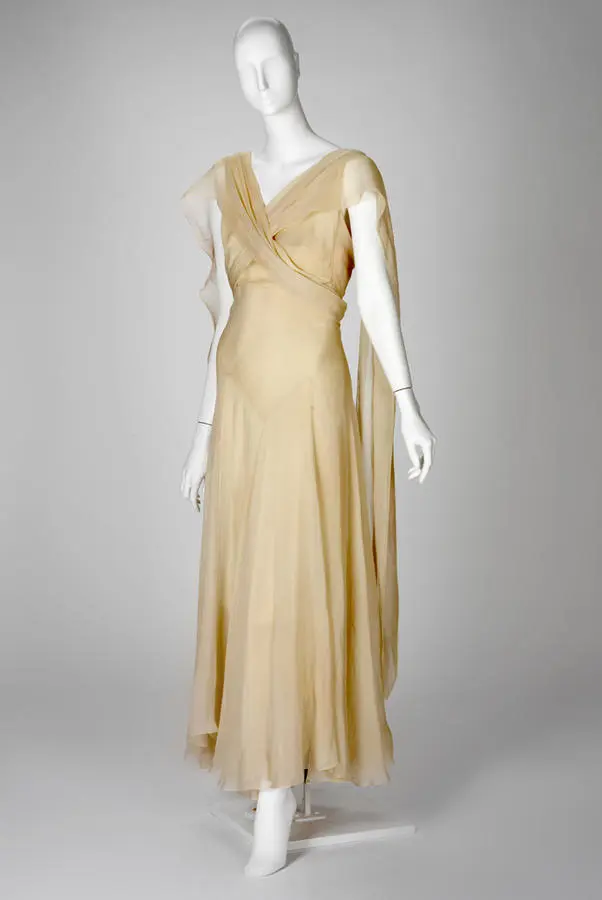
Look at the RISD Museum evening dress photographed here, made around 1932 in ombré silk chiffon crepe. Colour fades softly, but the real event is directional: panels cross the torso, release into the skirt and continue into long floating lengths. The dress is not a flat front with decoration applied. Its image is produced by how the fabric travels around the body.
Learn what ‘bias’ should change
In a woven cloth, lengthwise and crosswise threads establish the straight grain. Cutting on the diagonal can introduce more give and a different drape, but the phrase ‘bias cut’ is not proof of quality. Turn the garment inside out. Follow the grain, panels and seams. Do they create a coherent path, or does one side collapse while the other twists? A convincing cut looks intentional from shoulder to hem, not only seductive in a product photograph.
Material still matters. A light crepe may flow, a satin may reveal every pull, and a firmer weave may use diagonal panels for shaping rather than liquid cling. Ask what the fibre is, whether the dress is lined, and where it is meant to release from the body. ‘Bias’ describes direction; it does not guarantee comfort, opacity, durability or a flattering fit for every wearer.
Run the seven-minute fitting-room test
First, stand naturally for one minute and let the dress settle. Check the neckline, side seams and hem without posing. Then walk ten steps, sit fully, rise, reach forward and lift both arms only as high as ordinary life requires. Turn your back to the mirror. A dress can look serene from the front while its back seam climbs, its lining catches or its hem spirals after movement.
Measure only after that sequence. Note the useful points—shoulder to hem, waist or hip where the cut is closest, and the length of any slip or lining—rather than treating the size label as evidence. If the garment is expensive, ask whether hemming must wait for the fabric to rest and whether the alteration specialist understands bias construction. A careless straight hem can erase the balance you are paying for.
Build modesty without freezing the line
For a Gulf wardrobe, the best bias piece may be a quiet inner column rather than an exposed evening slip. Try a long opaque dress beneath an open architectural abaya, or a fluid skirt with a precise tunic that ends before the fullest movement begins. Choose one layer to skim and another to frame. Two clingy layers pulling in different directions create friction, heat and a silhouette neither designer intended.
Check the garment in daylight and under strong indoor light; pale chiffon and satin can change dramatically. Test the actual underlayer you plan to wear, because seams and elastic may become part of the surface. If coverage needs a fitted top or slip, make it smooth and breathable enough for the climate, then repeat the movement test. Modesty is successful when it belongs to the construction, not when it is improvised after purchase.
Style the movement, then protect it
Let a bias dress remain the active element. With black, add one long earring or sculptural cuff, a compact bag and a shoe that keeps the posture easy. For beauty, echo the method rather than the period: satin skin, a taupe or charcoal wash following the eye, softly separated lashes and one rose-brown or muted berry lip. Avoid turning a 1930s reference into costume unless costume is the point.
Before buying, read the care label and ask how that exact fibre, lining and construction should be stored. Some delicate pieces may distort under their own weight; others are designed to hang with support. Follow the maker or a qualified textile conservator rather than a universal social-media rule. After wear, inspect the hem, closures and stress points before putting the garment away. Vionnet’s lesson is attention: line is created by construction and preserved by care.
Vionnet’s legacy becomes richer when the myth becomes smaller. She did not need to invent a diagonal to transform modern dress; she understood what that diagonal could do when fabric, geometry and a moving body were allowed to negotiate. Bring the same intelligence to the fitting room. Read the inside, wait for the cloth to settle, sit and walk, build coverage into the silhouette and buy only when the line survives real life. That is a more useful kind of luxury than a famous name on a label: a garment that keeps its idea while you move inside it.
Editorial sources
- The Metropolitan Museum of Art — Vionnet, the bias-cut myth, three-dimensional draping and the spring 1931 dress (checked 18 August 2026)
- The Metropolitan Museum of Art — ca. 1936 evening dress, reduced-scale draping and whole-garment bias construction (checked 18 August 2026)
- RISD Museum — Madeleine Vionnet ombré silk chiffon evening dress, ca. 1932, object and CC0 image record (checked 18 August 2026)
- Wikimedia Commons — RISD Museum photograph and CC0 1.0 rights record (checked 18 August 2026)