Places & Style
The night-train edit: dress from platform to breakfast
A one-bag plan for choosing the right berth, dressing without hard edges, keeping beauty quiet in shared space and arriving ready for the city.
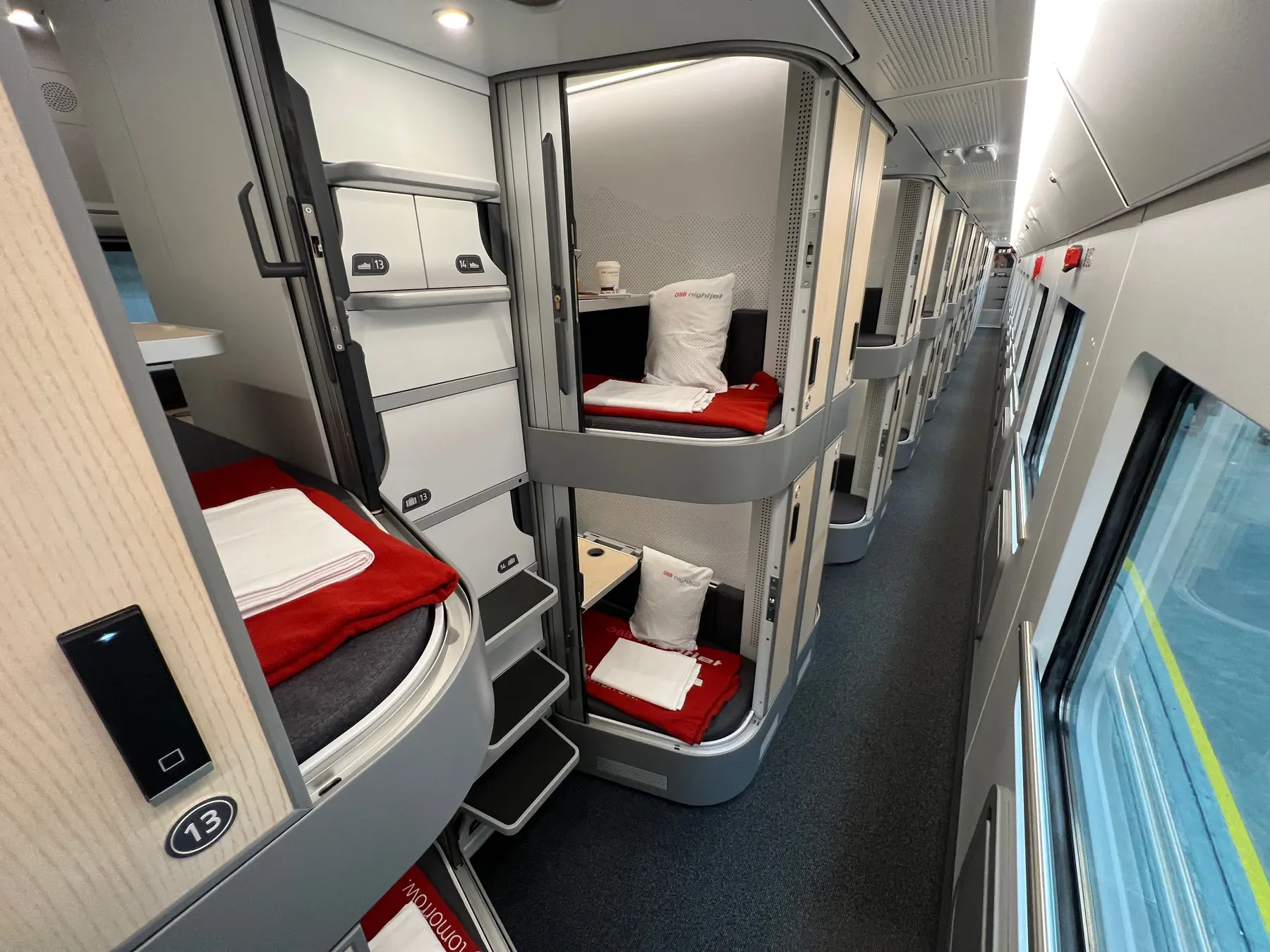
A night train is not a hotel on rails and not an airport with beds. It is a small moving room whose elegance comes from knowing exactly what must stay within reach. The best journey begins before the wardrobe: with the correct accommodation category, a bag that opens in one movement and an outfit that can sit, sleep and meet a city without becoming three separate costumes. This edit moves from platform light to breakfast light, keeping the black silhouette polished while respecting the people, space and timetable around it.
Book the room before you dress the journey
Read the operator’s current description of your exact train, date and accommodation—not a photograph from another route. A seat, couchette, sleeper and mini cabin offer very different privacy, bedding, wash facilities and storage. ÖBB Nightjet, for example, lists separate categories and notes that some sleeping compartments have a private shower and toilet, while its newer mini cabins use lockers with stated dimensions. Those details are examples, not promises for every night train.
Ask five questions before checkout: Is the space shared or private? Can it be secured from inside? What bedding and toiletries are included? Where does luggage go? When is breakfast or arrival service? Save the answers with the ticket. The most luxurious upgrade is sometimes not a larger bag or a smarter coat, but a category that lets the traveller manage privacy, clothing and sleep with less friction.
Build a two-zone bag
Divide the luggage by time, not by product type. Zone one is the night kit: ticket and identification, phone and cable, prescribed essentials, water, a soft layer, fresh socks, toothbrush, minimal skincare and the morning top. Zone two is everything the destination can wait for. Put the night kit in one small cube or pouch near the opening so the main case can remain closed.
Keep valuables under your control and follow the operator’s luggage policy. Never assume the locker size shown on one train applies to another, and never let a suitcase occupy an aisle, doorway or someone else’s berth. A compact soft bag usually negotiates a small cabin more gracefully than a rigid case, but the published dimensions and staff instructions—not aesthetics—make the final decision.
Wear one black line with soft architecture
Begin with a breathable long-sleeved base and fluid black trousers, a knit column or a generous skirt that does not bind when seated. Add a fine cardigan, unstructured jacket or long overshirt, then a scarf that can warm the shoulders without becoming bedding. Secure flats or refined trainers make platform changes safer and calmer than shoes chosen only for the arrival photograph.
Remove the hard edges before sleep: large earrings, sharp hair clips, a rigid belt and anything that catches on a berth. Store jewellery rather than leaving it on a ledge. In the morning, one precise layer restores the line—a clean collar, light jacket or sculptural scarf. Repetition is the point: the same black foundation should look intentional at departure and composed at breakfast.
Make the beauty ritual almost silent
In a shared compartment, beauty is a private, low-scent practice. Cleanse gently with a familiar product, moisturise if you normally do, care for the lips and tie hair without spraying the air around other passengers. Skip experiments, strong fragrance and a crowded counter of bottles. The journey is not the moment to test an active ingredient or perform a routine that needs perfect light and running water.
For arrival, edit the makeup to what can be applied seated and without rushing: sunscreen when appropriate for the day ahead, a comfortable complexion product, brow definition, mascara if desired and one lip or cheek colour. Follow each cosmetic label and your usual tolerances; this is styling guidance, not medical advice. If the train is moving sharply, close the mirror and wait.
Leave the cabin ready for morning
Before settling, confirm the stop and expected arrival, set a quiet alarm, place shoes and the morning layer together, and learn how to contact the train team. Use the lock or closure exactly as the operator explains; Nightjet’s own FAQ, for example, distinguishes lockable sleeping and couchette spaces from seating compartments that cannot be secured in the same way. Keep voices, screens and scents discreet, especially when the room is shared.
Have a delay card as well as an outfit card: operator contact, onward booking, accommodation address and the passenger-rights page for the jurisdiction you are travelling in. In the EU, official rail rights may provide assistance in specified disruption circumstances, but eligibility depends on the service and facts. At breakfast, check the berth, gather every cable and piece of jewellery, fold the blanket as instructed and step onto the platform with both hands free. Arrival is most elegant when nothing has been left behind.
The romance of a night train survives best when the practical work is already done. Choose the right space, keep the night kit near the zip, soften the black silhouette, lower the scent and prepare the morning before the lights go out. Then the train can do what it does beautifully: turn distance into a private sequence of windows, darkness and a city arriving with breakfast.
Editorial sources
- ÖBB Nightjet — sleeping-car categories and included facilities (checked 11 August 2026)
- ÖBB Nightjet — new-generation mini cabins and storage dimensions (checked 11 August 2026)
- ÖBB Nightjet FAQ — compartment locks and onboard amenities (checked 11 August 2026)
- European Union — rail passenger rights and disruption assistance (EU context; checked 11 August 2026)